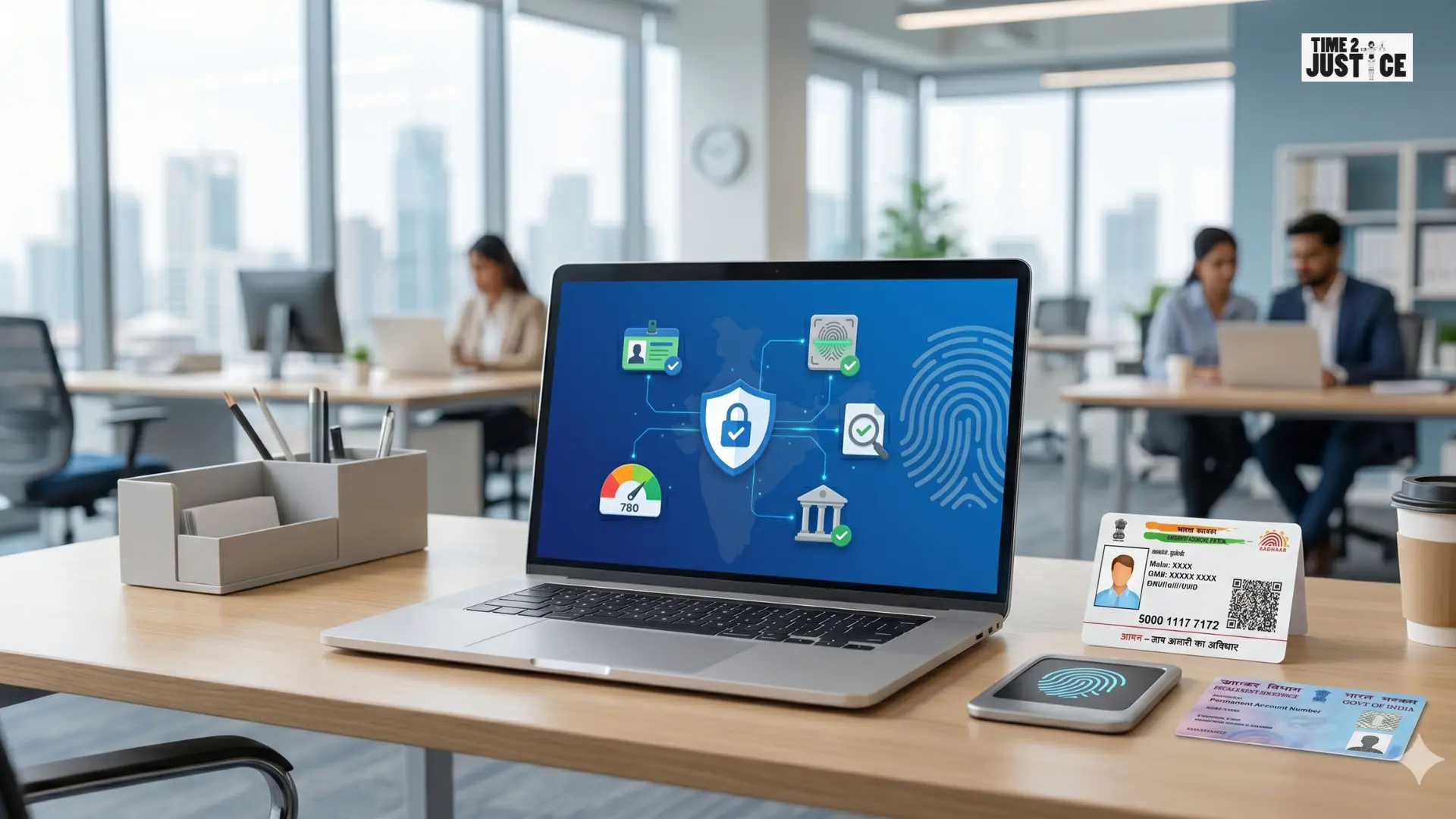
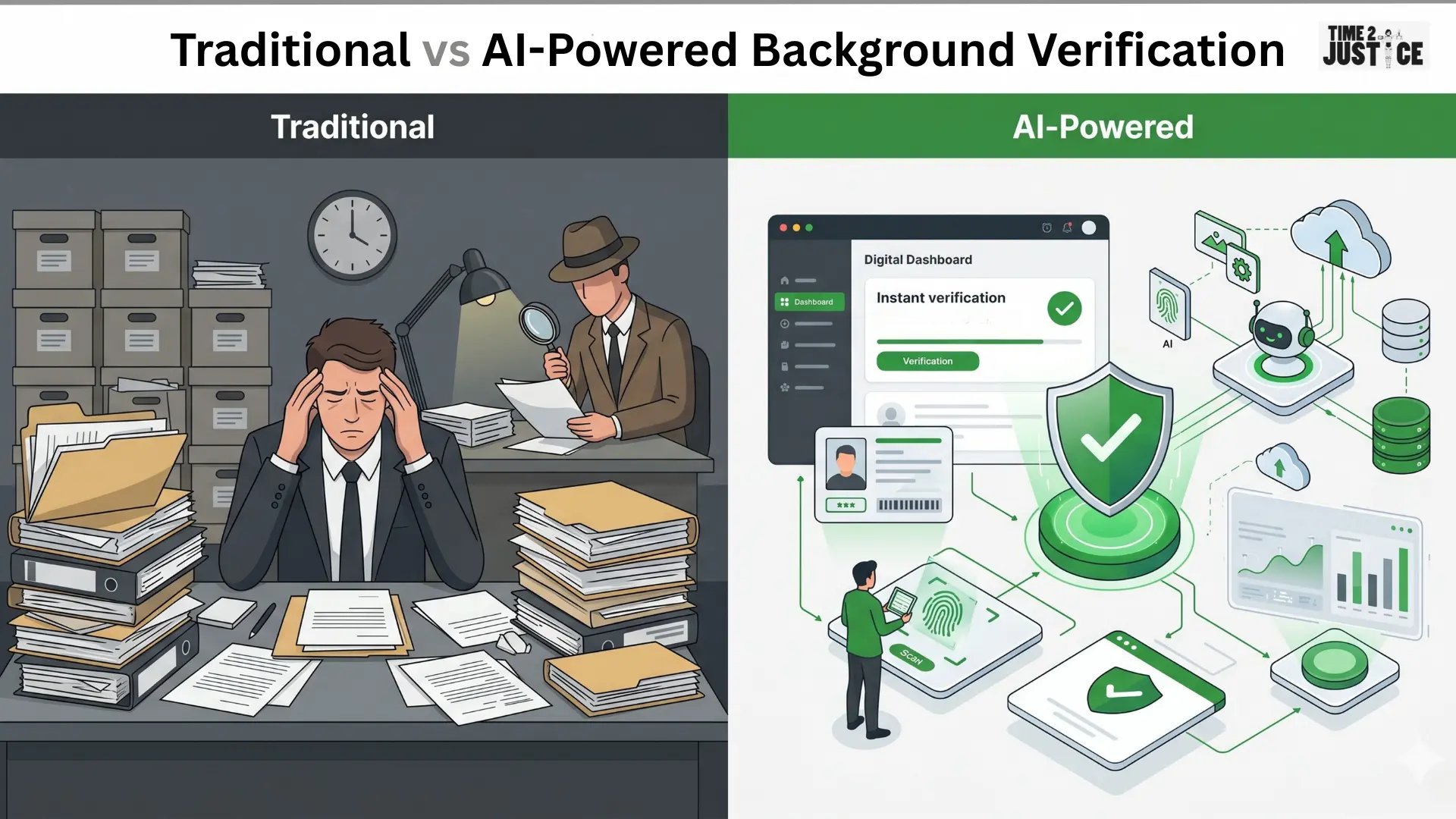
For decades, background verification in India involved hiring private investigators, waiting weeks for reports, and spending significant amounts of money, often without assurance of complete accuracy or reliability. Today, AI-powered verification has transformed the process by making it faster, more affordable, and more efficient.
| Factor | Traditional Background Check | AI-Powered Background Check (Time2Justice) |
|---|
| Time | Days to weeks | Results in minutes |
| Cost | ₹5,000–₹50,000+ | Affordable — starts at ₹499 |
| Accuracy | Manual and prone to errors | Automated, AI-validated data |
| Database Access | Limited | Real-time access to multiple government databases |
| Information Quality | Incomplete or outdated | Comprehensive and up-to-date reports |
| Scalability | One verification at a time | Bulk screening for hundreds of candidates |
| Availability | Requires human investigators | Self-serve and available 24/7 online |
| Report Quality | Inconsistent | Standardised and audit-ready reports |
AI-powered background verification is rapidly becoming the preferred choice for fast-scaling companies in India. It helps organizations improve efficiency, enhance accuracy, and detect discrepancies that traditional manual verification processes may overlook.
How AI Background Checks Work
AI-powered background verification works through a multi-step automated process designed to deliver faster, more accurate, and more reliable results than traditional verification methods.
Data Input
Users provide basic details such as full name, mobile number, date of birth, and the documents to be verified, including PAN, Aadhaar, passport, or other identity records.
Multi-Database Search
The AI system simultaneously searches multiple data sources in real time, including government databases, court records, credit bureaus, MCA filings, and other publicly available records.
Data Parsing and Cleaning
Using Natural Language Processing (NLP), the system converts unstructured information from scanned documents, court records, and public data into a structured and readable format.
Pattern Recognition and Risk Flagging
Machine learning models analyse the collected information to identify inconsistencies, discrepancies, suspicious patterns, or potential risk indicators.
Report Generation
The platform generates a comprehensive verification report covering identity verification, legal records, employment history, financial details, and other relevant information, often within minutes.
How to Run a Background Check Using Time2Justice
Time2Justice is India's AI-powered legal and verification platform that makes running a background check fast, affordable, and comprehensive. Here is how to do it:
Step 1: Visit https://www.time2justice.ai/ID-verification
Step 2: Click on AI Background Check from the homepage or navigate via Services → Background Verification → Profiling and Verification
Step 3: Select your check type — Individual, Company, or Others
Step 4: Select your service package — Instant Background Verification Service (₹499 + GST), Employee Offline Verification Service (₹1199 + GST), or both.
Step 5: Enter the required details — full name, mobile number, email address, date of birth, and any document numbers for verification
Step 6: Review and pay — your detailed background report is generated within minutes
The report includes credit score, court case search results, personal details verification, employment history, and identity document checks, all in one place.
What a Time2Justice Background Check Report Covers
When you run a background check on Time2Justice, your report includes:
-
Credit Score — financial health snapshot (300–900 scale)
-
Court Case Records — any ongoing or past legal cases
-
Identity Verification — PAN, Aadhaar, and address confirmation
-
Employment History — past roles and employer verification
-
Personal Profile — verified personal details and social presence
-
Company Data (for business checks) — MCA, GST, ROC, litigation records
For companies, the Corporate Background Check includes MCA and GST data. For proprietorships and partnerships, owner background checks and GST data are included.
Real-World Impact: Background Checks in Action
Manufacturing Firm, Kolkata
A manufacturing company used Time2Justice to screen multiple employees and vendors simultaneously. The platform helped streamline the verification process, significantly reduce manual workload, and identify vendor compliance issues, all before agreements were finalised.
Fintech Startup
A fintech lending platform integrated AI-powered credit analysis and identity verification to assess borrower risk more efficiently. This helped improve verification speed, reduce manual processing time, and strengthen fraud detection during the loan approval process.
Landlord, Mumbai
A property owner used Time2Justice to conduct a tenant background check before signing a rental agreement. The process helped verify identity, assess financial stability, and complete the full check in minutes, providing the confidence needed to finalise the lease without hesitation.
Background Checks and Indian Law: What You Need to Know
Running a background check in India is legal, but there are important compliance considerations that every employer, landlord, and individual should understand.
Consent is Required
Under Indian privacy norms and the Digital Personal Data Protection Act (DPDPA), 2023, you must obtain the subject’s written or digital consent before conducting a background check. This is standard practice in pre-employment screening and is integrated into platforms like Time2Justice.
Purpose Limitation
Background check data should only be used for the specific purpose for which it was collected, such as hiring, lending, or rental verification. Using the data for any other purpose without consent may violate the provisions of the DPDPA.
Data Security
Any platform handling background check data must maintain strong data security standards. Time2Justice is built on secure, encrypted infrastructure to help protect sensitive personal and financial information at every stage.
Right to Accuracy
If a background check report contains inaccurate information, the subject has the right to challenge and request correction of the data. Always use a reputable AI-powered platform that cross-verifies information from multiple data sources to improve report accuracy.
Fair Use
A background check report should be considered as one factor in the decision-making process, not the sole determinant. Any adverse findings should be handled fairly, and the individual should be given an opportunity to respond before a final decision is made.
Conclusion
A background check in India is no longer a luxury, it has become an essential part of responsible hiring, renting, lending, and partnership decisions. With AI-powered platforms like Time2Justice, the verification process is now faster, more affordable, and more comprehensive than ever before.
Whether you are an employer screening a candidate, a landlord verifying a tenant, a fintech company assessing borrower risk, or an individual reviewing a matrimonial profile , a background check provides the verified information needed to make informed decisions with greater confidence and security.
FAQ
Is a background check legal in India?
Yes. Background checks are legal in India when conducted with the individual’s consent and in compliance with applicable data protection laws.
Can I run a background check on myself?
Yes. Many individuals run self-checks before applying for jobs, loans, or rental agreements to understand what appears in their public records.
How long does a background check take?
On AI-powered platforms like Time2Justice, results are available within minutes. Traditional manual checks can take anywhere from two to three weeks.
Are online background checks accurate?
AI-powered platforms that access verified government databases and court records are often more accurate than manual verification processes, which can be prone to human error.
Can a company background check reveal fraud?
Yes. A company background check covering MCA, ROC, GST, and litigation records can help identify non-compliance, financial irregularities, and pending legal disputes before entering into a contract.