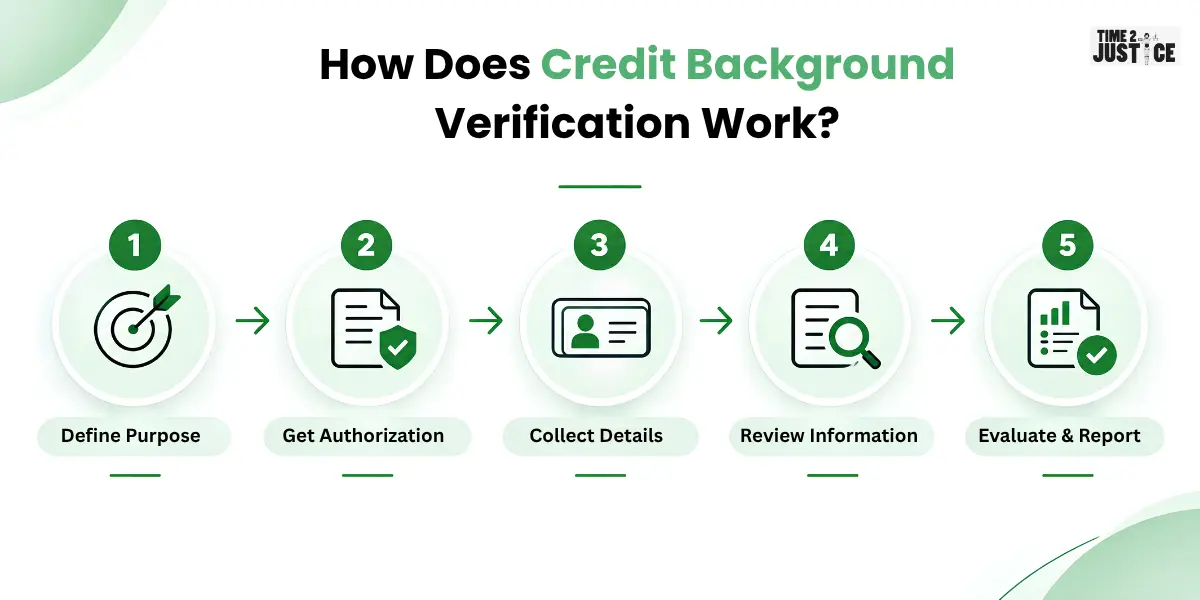
The credit background verification process depends on the service provider, verification purpose, and available information.
A typical process may involve the following steps.
Step 1: Define the Verification Purpose
First, identify why the credit-related check is required.
Possible purposes may include:
- Financial due diligence
- Relevant business verification
- Loan-related assessment by an authorized lender
- Other permitted verification needs
The purpose should determine the scope of information collected.
Step 2: Obtain Appropriate Authorization
Before accessing or processing personal credit information, organizations should identify applicable legal requirements and authorization conditions.
Credit information is sensitive, and access must follow the relevant legal and regulatory framework.
Step 3: Collect Relevant Details
Depending on the verification service, the required information may include identity details and documents needed for matching or verification.
Organizations should avoid collecting unnecessary information.
Step 4: Review Available Information
The verification process may involve reviewing relevant records and identifying information that requires clarification.
Automated tools can support certain information-processing tasks, but results should be interpreted carefully.
Step 5: Evaluate the Report Responsibly
The final report should be considered alongside the purpose of the verification and other relevant information.
A credit report should not be used as the sole basis for making decisions that could unfairly affect an individual.
Credit Background Checks for Employment
An employee credit background check involves reviewing credit-related information in an employment context.
Some employers may consider financial verification relevant to specific responsibilities, particularly where a role involves financial access or sensitive financial duties.
However, a credit check should not automatically be required for every employee or job position.
Employers should consider:
- Whether the check is relevant to the role
- Whether the check is legally permissible
- Whether appropriate authorization is required
- How the information will be protected
- How inaccuracies or disputed information will be handled
Is a Credit Check Necessary for Every Employee?
No. The relevance of a credit check depends on the role, purpose, and applicable requirements.
For example, a position involving financial management may raise different verification considerations from a role that does not involve financial responsibilities.
Employers should avoid assuming that a person's credit history determines their professional ability or trustworthiness.
Credit information should be used proportionately and responsibly.
Credit Background Verification vs. Other Background Checks
Credit verification is only one component of background checking.
Different checks serve different purposes.
| Verification Type | Primary Purpose |
|---|
| Credit background check | Review relevant credit-related information |
| Identity verification | Confirm identity details |
| Employment verification | Check relevant employment history |
| Address verification | Confirm address-related information |
| Court-record check | Search relevant court or litigation records |
| Business verification | Review relevant company or business information |
The appropriate verification depends on the requirements of the organization and the person or entity being checked.
For example, an employer may require employment and identity verification, while a business assessing a potential counterparty may need a broader due diligence process.
A single verification type cannot establish every aspect of an individual's or organization's background.
How AI Supports Credit Background Verification
AI-powered background verification platforms can help streamline certain verification workflows.
Depending on the system's capabilities, AI may support tasks such as document processing, information organization, and identifying potential inconsistencies.
However, AI-assisted verification should not be confused with specialized credit fraud detection.
Document Processing
AI tools may help process uploaded documents and extract relevant information.
This can reduce repetitive manual work, depending on the quality of the documents and the technology used.
Information Organization
Verification platforms may organize information into reports, helping users review relevant details more efficiently.
Supporting Verification Workflows
AI can assist with selected workflow tasks, but the reliability of the outcome depends on data quality, system design, and appropriate review.
AI-generated information should not automatically be treated as verified fact.
Users should review important results and seek additional confirmation where necessary.
Credit-related information should be handled carefully because it can contain sensitive personal and financial details.
Organizations conducting credit background verification in India should consider the following principles.
Use Information for a Clear Purpose
The purpose of collecting or reviewing information should be defined in advance.
Organizations should avoid collecting information that is unrelated to the intended verification.
Follow Applicable Requirements
Credit information sharing and processing should follow relevant Indian laws, regulations, and guidelines. Organizations should refer to the Reserve Bank of India's official website for relevant regulatory information and updates.
Protect Personal Information
Organizations should implement appropriate safeguards to protect credit and personal information from unauthorized access, misuse, or disclosure.
Handle Errors Responsibly
Credit reports may contain inaccurate or outdated information.
Individuals should have appropriate channels to raise concerns and seek correction through the relevant credit information company or reporting institution.
Avoid Unfair Conclusions
A credit report should not be used to make unsupported conclusions about an individual's character, integrity, or suitability.
Organizations should consider relevant context and the purpose of the verification.
How Time2Justice Supports Background Verification
Time2Justice is an AI-powered legal and verification platform that supports background verification and other legal and document-related workflows.
Its background verification service provides different verification options depending on the selected service and the type of individual or entity being checked.
The service page lists an Instant Online Check with credit report and court case checks, along with other background verification options. The exact scope depends on the selected service.
Businesses and individuals can explore the Time2Justice background verification service to understand the available options.
Before initiating a verification, users should review the service scope, information requirements, applicable terms, and privacy information.
Time2Justice's verification services can be considered as part of a broader due diligence process. However, a credit report or background verification result should not be treated as conclusive proof of fraud.
Benefits and Limitations of Credit Background Checks
Credit background checks can provide relevant information, but they also have limitations.
Potential Benefits
- Support relevant financial due diligence
- Help users review reported credit-related information
- Provide information for appropriate verification processes
- Support informed decisions when combined with other relevant checks
Limitations
-
Credit reports may contain errors or incomplete information.
-
Credit history does not represent a complete financial profile.
-
A credit score does not establish whether someone has committed fraud.
-
Credit checks may not be relevant to every verification purpose.
-
Access and use of credit information are subject to applicable requirements.
Businesses should use credit-related information carefully and avoid relying on a single report for important decisions.
Conclusion
A credit background check in India can help organizations review relevant credit-related information as part of a broader verification process.
Credit report verification may provide insights into reported credit history, accounts, and repayment-related information, depending on the report and available records.
AI-powered background verification platforms can support selected verification workflows, but their capabilities and limitations should be understood before relying on their results.
For employers and businesses, the purpose of the check, relevance of the information, privacy safeguards, and applicable legal requirements should guide the verification process.
Time2Justice provides background verification services that users can explore based on their specific requirements.
FAQs
What is a credit background check in India?
A credit background check in India involves reviewing an individual's credit-related information. It helps businesses understand relevant financial details, subject to proper authorization and applicable regulations.
How does credit report verification work?
Credit report verification involves checking information from an authorized credit information provider. It may include reviewing credit accounts, repayment history, outstanding balances, and credit enquiries.
Is a credit background check legal in India?
Yes, credit background checks should follow applicable Indian laws and data protection requirements. Organizations should obtain the necessary consent or authorization and use credit information responsibly.
What information is included in a credit report?
A credit report may include credit accounts, repayment history, outstanding balances, credit enquiries, and credit scores. The information depends on the credit information provider.
How can businesses conduct credit background verification?
Businesses can use authorized credit information services or background verification providers. They should verify information responsibly, obtain proper authorization, and protect personal financial data.
Disclaimer:
This article is intended for informational purposes only and does not constitute legal, financial, or professional advice. Credit background checks and verification services should be used in accordance with applicable laws, regulations, authorization requirements, and data protection principles. Verification results should be reviewed appropriately before making important decisions.