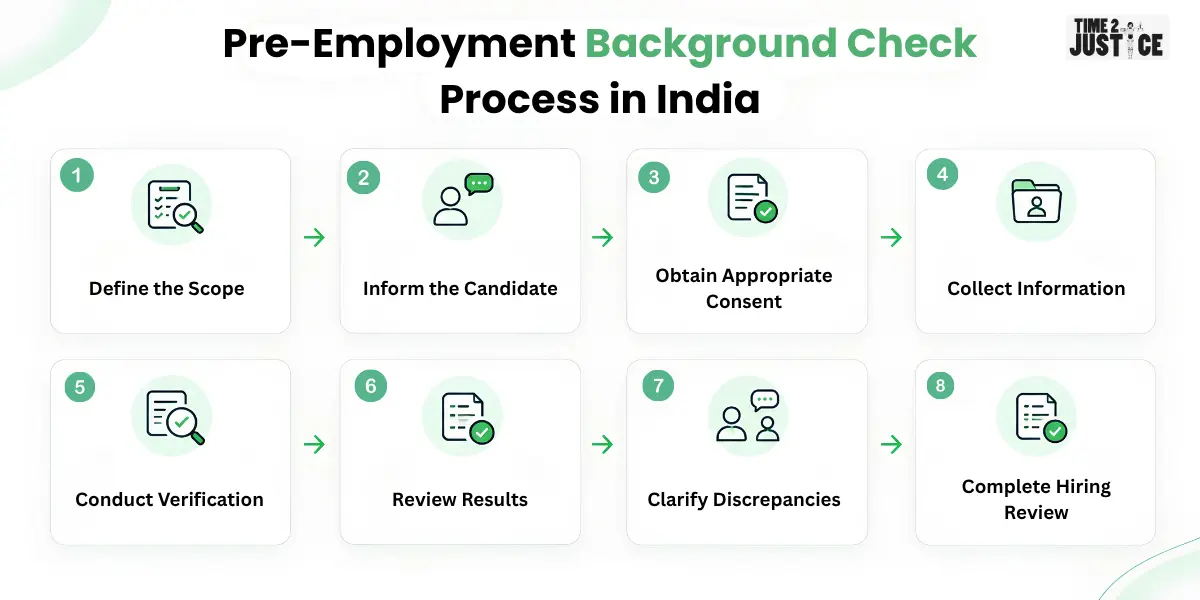
Although processes differ between organisations, a structured pre-employment background check generally follows these steps.
Step 1: Define the Verification Scope
First, determine which checks are relevant to the position.
For example:
| Role Requirement | Possible Verification |
|---|
| Previous experience required | Employment verification |
| Specific degree required | Education verification |
| Financial responsibility | Relevant financial/credit checks |
| Sensitive role | Additional role-specific verification |
| Physical location important | Address verification |
Not every candidate needs every type of check.
Step 2: Inform the Candidate
The candidate should be informed that verification will be conducted and what information or checks are relevant to the process.
Employers should use clear privacy and data-handling practices appropriate to the information being collected.
Step 3: Obtain Appropriate Consent
Where consent is the applicable legal basis or otherwise required for the processing involved, employers should obtain it in an appropriate and documented manner.
India's digital personal data protection framework is being implemented through a phased commencement structure. Employers should therefore verify the provisions currently applicable to their specific processing activities under the Digital Personal Data Protection Rules, 2025.
Step 4: Collect Required Information
The employer or verification provider collects only the information needed for the selected checks.
This may include:
- Candidate name
- Contact information
- Identity details
- Education details
- Previous employment information
- Address details
- Supporting documents
Step 5: Conduct Verification
The submitted information is then checked against the relevant sources or verification methods.
Depending on the service, verification may be:
- Digital
- Database-based
- Document-based
- Employer/reference-based
- Physical or offline
Step 6: Review the Verification Report
The verification results should be reviewed rather than treated as an automatic hiring decision.
HR or the relevant decision-maker can identify:
- Verified information
- Information that could not be verified
- Inconsistencies
- Missing information
- Issues requiring clarification
Step 7: Give the Candidate an Opportunity to Clarify
If a material discrepancy is identified, employers may need to seek clarification from the candidate before reaching a final decision.
A discrepancy does not necessarily mean that the candidate has provided false information. Differences can sometimes result from administrative errors, changes in employment records, name variations, or incomplete information.
Step 8: Complete the Hiring Review
Background verification should be considered alongside other relevant hiring information, including:
- Interview performance
- Skills
- Qualifications
- Experience
- References
- Role requirements
The verification report should be one part of the overall hiring process.
Pre-Employment Background Check Checklist for Employers
Before starting verification, HR teams can use the following checklist:
- Define which checks are relevant to the position
- Inform the candidate about the verification process
- Determine the appropriate legal basis and consent requirements
- Collect only necessary information
- Verify identity information
- Verify employment history where relevant
- Verify educational qualifications where relevant
- Conduct address or physical verification where required
- Conduct role-specific checks where appropriate
- Review the verification report
- Investigate material discrepancies
- Give the candidate an opportunity to clarify relevant findings
- Document the verification process
- Securely handle verification records
A checklist can help HR teams create a more consistent screening workflow.
When Should a Pre-Employment Background Check Be Conducted?
There is no single timing requirement for every organisation.
Many employers conduct background verification after a conditional offer and before the candidate joins. Others may begin relevant checks earlier in the recruitment process depending on the role, company policy, and applicable requirements.
The important point is to establish a consistent process and communicate the verification requirements clearly.
For sensitive or regulated positions, additional verification may also be required according to the organisation's policies or applicable industry requirements.
How Long Does a Pre-Employment Background Check Take?
The turnaround time depends on the type and depth of verification.
A simple digital check may be completed relatively quickly, while other checks can take longer because they may require document review, employer responses, reference checks, or physical verification.
Factors affecting turnaround time include:
- Number of checks
- Availability of candidate information
- Type of verification
- Response time from previous employers or institutions
- Whether physical verification is required
- Verification provider's process
Therefore, employers should avoid assuming that every background check will be completed within the same timeframe.
How Much Does a Pre-Employment Background Check Cost in India?
The cost of a pre-employment background check varies depending on the verification scope and service provider.
Common factors include:
| Factor | Why It Matters |
|---|
| Number of checks | More checks can increase the total cost |
| Verification type | Digital and physical checks may have different pricing |
| Candidate volume | Bulk requirements may use different pricing models |
| Turnaround time | Faster processing may affect pricing |
| Reporting | Different providers may offer different report formats |
| Role requirements | Specialised verification can require additional work |
Instead of comparing providers only on price, employers should compare scope, verification method, turnaround time, reporting, data handling, and support.
What Happens If a Background Check Finds a Discrepancy?
A discrepancy should be reviewed carefully rather than treated as an automatic reason to reject a candidate.
For example, a difference in employment dates may have a straightforward explanation. Similarly, variations in names or addresses can sometimes result from legitimate changes or administrative records.
A sensible process is:
- Identify the discrepancy.
- Check the source of the information.
- Compare it with the candidate's submitted information.
- Ask the candidate for clarification where appropriate.
- Review supporting documents if required.
- Consider the relevance of the issue to the role.
- Document the outcome.
The objective should be to make a well-informed hiring decision based on relevant and properly reviewed information.
Digital vs Physical Pre-Employment Verification
Employers can use different verification methods depending on the requirement.
Digital Verification
Digital verification can be useful when information can be checked electronically.
Advantages may include:
- Faster processing
- Easier document collection
- Digital workflows
- Centralised reports
- Better scalability for larger hiring volumes
Physical Verification
Some requirements may benefit from offline or physical verification, particularly where information needs to be checked at a physical location.
Physical verification may take longer and can involve additional operational steps.
The appropriate method depends on the type of information being verified and the employer's requirements.
How to Choose a Pre-Employment Background Verification Provider
Before selecting a verification provider, employers should consider more than just the advertised price.
Verification Coverage
Check exactly which verification services are included.
Turnaround Time
Ask how long each verification type generally takes rather than relying only on a general turnaround claim.
Reporting
The final report should clearly distinguish verified information, discrepancies, unavailable information, and other relevant findings.
Data Handling
Ask how candidate information is collected, stored, processed, shared, and protected.
Digital and Physical Options
If your organisation hires across locations, check whether the provider supports both digital and physical verification where required.
Scalability
Businesses with regular or high-volume recruitment should consider whether the provider can handle multiple candidates efficiently.
For a broader discussion of selecting a provider, see How to Choose the Right Background Check Service in India.
How Time2Justice Supports Pre-Employment Background Verification
Time2Justice provides background verification services that businesses can use as part of their candidate screening workflow.
Depending on the requirement, businesses can explore different verification options through the Time2Justice Background Verification Service, including verification of identity, employment, education, address, and other relevant candidate information before hiring.
Employers can select the verification scope based on the role, information being verified, and their organisation's internal hiring process.
The appropriate verification method may vary depending on the type of check required. Employers should review verification results carefully before making employment decisions. Background verification is an information-gathering and verification step; it does not replace HR review, professional judgment, or legal advice.
Conclusion
A pre-employment background check in India can help employers verify important candidate information before finalising a hiring decision.
A structured process should begin by defining the required checks, informing the candidate, collecting necessary information, conducting verification, reviewing the results, and addressing relevant discrepancies.
The right approach depends on the role and the organisation's requirements. Employers should avoid using every possible verification check for every candidate and instead focus on checks that are relevant, proportionate, and properly handled.
Most importantly, background verification should support—not replace—the broader hiring process.
This article provides general informational guidance and is not legal advice. Employers should review their specific requirements with an appropriate professional where necessary.
Frequently Asked Questions
What is a pre-employment background check?
A pre-employment background check is the process of verifying relevant information about a job candidate before hiring. It can include identity, education, employment history, address, references, and other role-specific checks.
What does a pre-employment background check include in India?
It may include identity verification, employment verification, education verification, address verification, reference checks, court or legal record checks, and other checks relevant to the position.
Are pre-employment background checks mandatory in India?
Background verification is not a universal requirement for every job or industry. However, particular organisations, roles, contracts, or regulated sectors may have specific verification requirements.
When should an employer conduct a background check?
Many employers conduct verification after a conditional offer and before joining, but the timing can vary according to the organisation's process, role, and applicable requirements.
How long does pre-employment verification take?
The timeline depends on the type of checks being conducted. Digital checks may be relatively quick, while employment, reference, document, or physical verification can take longer.
How much does employee background verification cost?
There is no single fixed cost. Pricing depends on the verification types, number of candidates, physical or digital checks, turnaround time, and provider.
What happens if a candidate's background check has a discrepancy?
The employer should review the discrepancy, verify the underlying information, and give the candidate an appropriate opportunity to clarify relevant findings before making a decision.
Is consent required for a pre-employment background check?
Consent and other legal requirements depend on the nature of the personal-data processing and the applicable legal framework. Employers should use appropriate privacy notices, legal bases, and consent mechanisms where applicable.