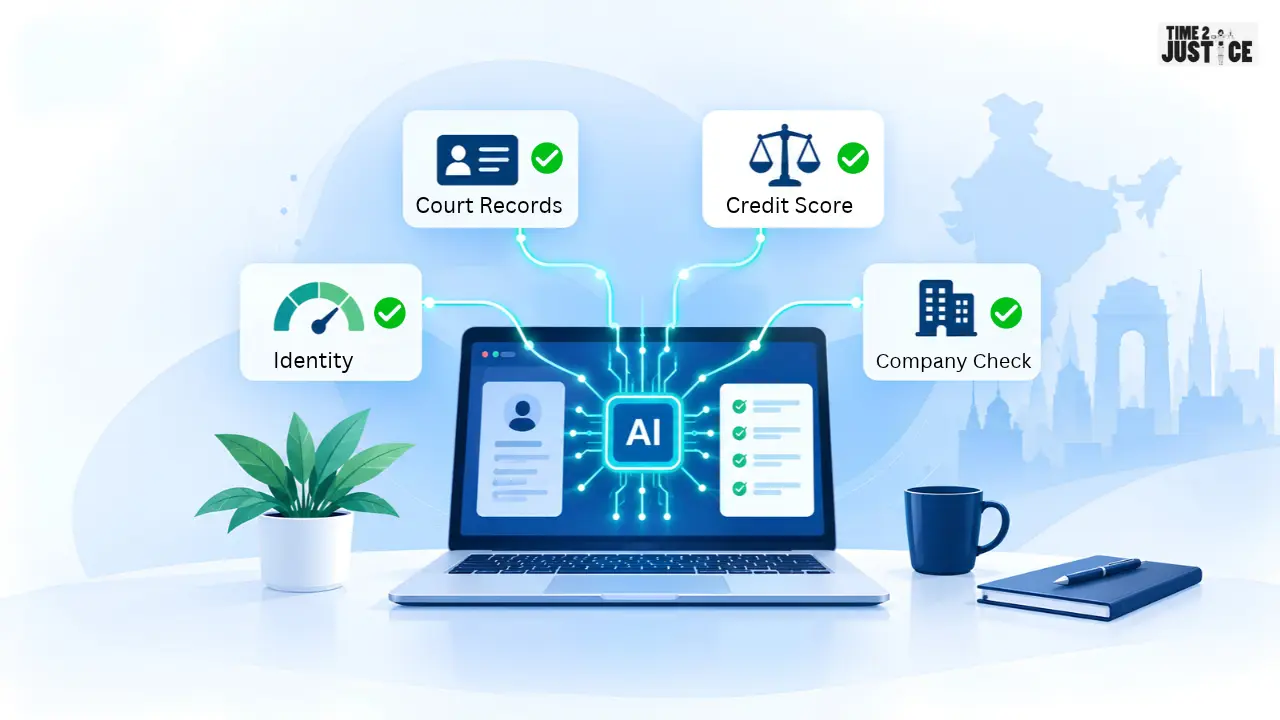
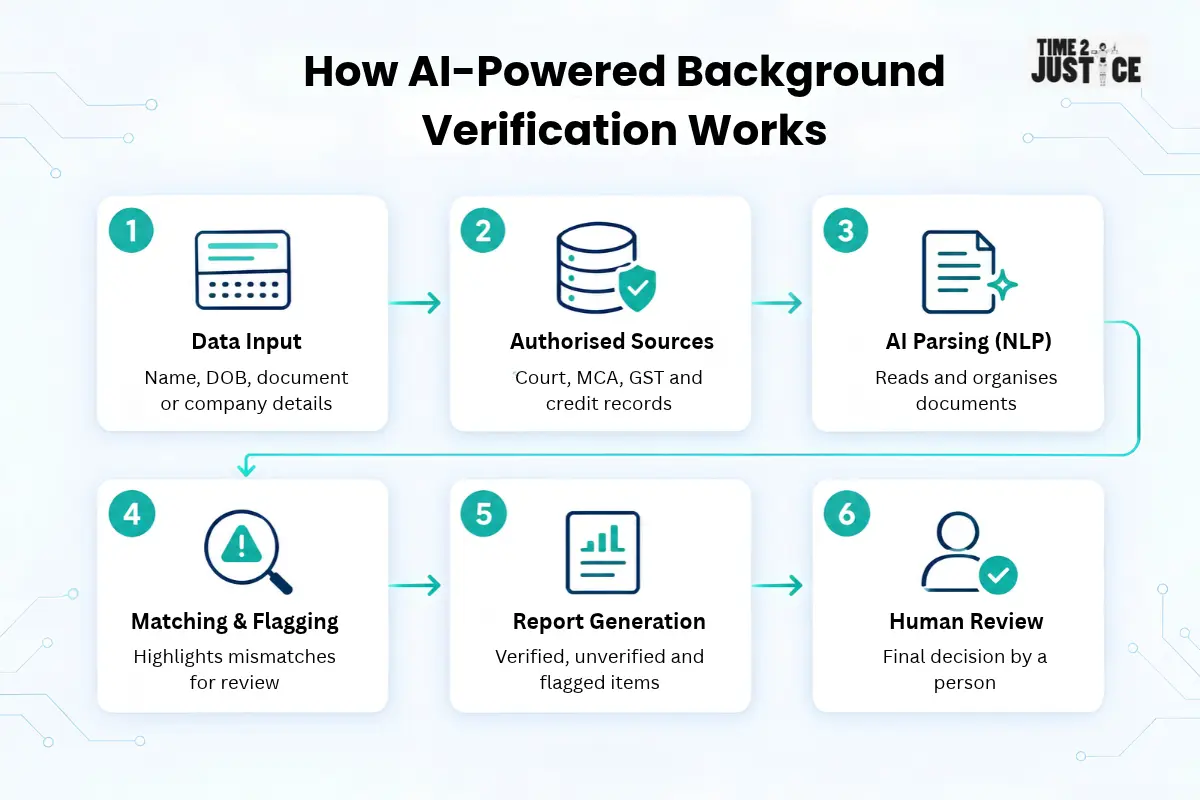
Most AI verification platforms follow a similar process.
1. Data Input
The user enters basic details about the person or business, such as name, date of birth, contact details and document numbers, or a company name, CIN or GSTIN. Many platforms also allow document upload.
2. Data Collection From Authorised Sources
The system searches relevant sources, which may include:
- Court and case records (such as eCourts data)
- Company records from the MCA portal
- GST registration information
- Credit information, accessed through authorised channels with the person's authorisation
- Documents and details provided by the person being verified
The exact sources depend on the platform, the type of check and the legal permissions in place.
3. Data Parsing and Organisation
Using natural language processing (NLP), the system reads unstructured information, such as scanned documents and court records, and converts it into a structured, readable format.
4. Matching and Flagging
Matching logic and machine-learning models compare the information collected with the details provided, and flag mismatches, possible duplicates or records that need a closer look.
5. Report Generation
The platform produces a standardised report showing what was verified, what could not be verified, and what needs clarification.
6. Human Review
The report is then reviewed by the employer, landlord, business or individual who requested it. Flagged items should always be checked and, where relevant, discussed with the person before a decision is made.
Top Features of AI Background Verification Systems
| Feature | What it does |
|---|
| Court and litigation search | Searches available court records for cases linked to a person or company |
| Identity document verification | Checks document details such as PAN, passport or driving licence, with consent |
| Credit report review | Shows reported credit history, accessed with the person's authorisation |
| Company and GST data | Pulls company registration, status and GST details from public records |
| Document reading (OCR/NLP) | Extracts information from uploaded and scanned documents |
| Discrepancy flagging | Highlights mismatches between submitted and verified information |
| Standardised reports | Presents results in a consistent, easy-to-compare format |
| Online and offline options | Combines instant digital checks with physical field verification where needed |
| Ongoing monitoring | Alerts users to changes such as new litigation (on some platforms) |
| API integration | Connects with HR, ATS or onboarding systems (on some platforms) |
Not every platform offers every feature, so check what is included before you choose a service.
AI background checks are useful for organisations of every size, each with different needs.
Corporates and Large Enterprises
- Employee verification at scale, across locations
- Vendor and supplier due diligence
- Dealer and distributor checks before extending credit
- Sanctions and watchlist screening where required for compliance
- Integration with HRMS and procurement systems
Startups and SMEs
- Affordable, pay-per-check verification without a large compliance team
- Fast verification during rapid hiring
- Checking freelancers, consultants and new business partners
Sole Proprietors and Freelancers
- Verifying new clients before starting work
- Running a self-check to build credibility with clients
Educational Institutions
- Verifying the qualifications and past employment of faculty and staff
- Additional screening for roles involving students
Key Use Cases by Industry
Manufacturing OEMs: Dealer and Distributor Credit Assessment
For manufacturers (OEMs) selling through distributors, dealers and retailers, AI-powered background verification can help assess channel partners before extending credit.
Supplying stock on credit carries risks, including unpaid dues, payment disputes and bad debts. Since many dealers operate as proprietorships or partnerships, checking both the business and its owners is important.
Before onboarding a dealer or setting a credit limit, OEMs can use background verification to review:
- Business legitimacy: GST registration status, legal name and company details from MCA records, where applicable.
- Litigation history: Relevant court cases involving the business or its owners, including cheque-bounce disputes.
- Owner and promoter background: Identity details and relevant court records.
- Credit information: Credit reports accessed with the required authorisation through appropriate channels.
- Record consistency: Whether application details match available official records.
AI can help OEMs apply these checks consistently across dealers in different regions. Periodic reviews can also support credit-limit renewals or increases.
Verification findings should be considered alongside trade references, payment history and sales potential. A court case or low credit score should prompt further review, not automatic rejection.
Banking, NBFCs and Fintech
- Identity verification during customer onboarding (as part of KYC processes)
- Reviewing credit reports for loan decisions, through authorised channels
- Vendor and partner due diligence
Recruitment and Staffing
- Faster verification of candidates' identity, employment and education
- Consistent screening across large hiring volumes
- Spotting discrepancies in resumes before onboarding
Real Estate and Housing Societies
- Tenant verification before signing a rental agreement
- Verifying domestic staff, security guards and contractors
- Due diligence on builders and sellers
Healthcare
- Verifying medical registrations and qualifications
- Additional screening for staff who handle patients or patient data
Supply Chain and Logistics
- Supplier and vendor checks using MCA and GST data
- Reviewing litigation history before signing supply contracts
- Verifying drivers and warehouse staff
Benefits for Enterprises and Individuals
For Enterprises
- Faster onboarding: many digital checks are completed in minutes instead of days
- Lower cost per check: automation reduces manual effort
- Consistency: every check follows the same process and report format
- Scalability: hundreds of verifications can run at once
- Better records: digital reports and consent records support audits
For Individuals
- Self-verification: check your own records before applying for a job, loan or rental
- Safer personal decisions: verify a business partner or service provider before committing
- Affordable access: professional verification without hiring an agency
What AI Cannot Do
AI makes verification faster, but it does not replace human judgment. It is important to understand its limits:
- It depends on available data. If a record is not digitised or not in the sources searched, it will not appear.
- Name matches can be wrong. Common names can produce false matches, so results must be confirmed with additional identifiers.
- A record is not a verdict. A court case or FIR linked to someone does not prove guilt, and their role in the case must be checked.
- Context needs a human. AI can flag a discrepancy, but a person must decide whether it matters.
- A clean report is not a guarantee. It means nothing was found in the sources searched, not that nothing exists.
The best approach combines AI's speed and consistency with human review for interpretation and final decision-making. For a closer look at the differences, read our Traditional Background Checks vs AI Verification: Which Is Better?.
Legal, Ethical, and Compliance Considerations
Data Privacy
- Follow India's Digital Personal Data Protection Act, 2023 and the DPDP Rules, 2025, whose obligations are being brought into force in phases.
- Collect only the information needed for the check.
- Store reports securely, restrict access, and delete data when it is no longer needed.
Consent and Transparency
- Inform the person that a check will be done and what it covers.
- Obtain documented consent wherever it is required, and always for sensitive checks such as credit reports.
- Use Aadhaar only where permitted, with consent, and preferably in masked form or through official verification methods.
- Give the person a chance to explain or correct any adverse finding.
Fairness and Bias
- AI systems should be tested regularly to avoid unfair outcomes based on gender, caste, region or other personal characteristics.
- Automated flags should support decisions, not make them on their own.
This section is general information, not legal advice. For sector-specific requirements, consult a qualified lawyer.
| What to check | Why it matters |
|---|
| Types of checks offered | Make sure it covers what you need: identity, court, credit, company, address |
| Data sources | Ask which sources are used and whether access is authorised |
| Consent process | The platform should support documented consent |
| Online and offline options | Some checks, like physical address verification, need field work |
| Report clarity | Reports should separate verified, unverified and flagged items |
| Data security and retention | Ask how data is stored, who can access it and when it is deleted |
| Transparent pricing | Check the price per check and any extra charges |
| Support and scalability | Important if you verify many people regularly |
For a more detailed checklist to help you evaluate providers, read our How to Choose the Right Background Check Service in India.
The Future of Background Verification: Trends and Technologies
- Continuous monitoring: instead of a one-time check, organisations may increasingly track relevant changes, such as new litigation involving key vendors.
- Digital credentials: verified digital documents, such as those issued through DigiLocker, can make education and identity checks faster.
- Stronger consent tools: as data-protection rules come into force, consent management and audit trails will become standard features.
- Better matching: improved AI models may reduce false matches for common names.
How Time2Justice Uses AI for Background Verification
Time2Justice is an AI-powered legal and verification platform that helps individuals and businesses run background checks online.
| Service | What it covers | Price |
|---|
| Instant Online Check | Credit report and court case check | ₹499 + GST |
| Offline Background Check | Physical field verification, address and identity check | ₹700 + GST |
| Individual Background Check (Combined) | Instant Online Check + Offline Background Check | ₹1,199 + GST |
| Corporate Background Check | MCA and GST data | ₹499 + GST |
| Proprietorship & Partnership Check | Owner background check and GST data | ₹499 + GST |
For the latest service details and pricing, visit the Time2Justice background verification pricing page.
AI can help organise available records and verification information into a structured report, while offline checks provide physical verification where required. Verification results should be reviewed carefully before making decisions.
To understand the process, read our guide on How to Run an Instant Background Check Online in India, or start a background check with Time2Justice.
Conclusion
AI-powered background verification has made checks faster, more affordable and more consistent for businesses and individuals in India. It helps employers hire with more confidence, helps businesses vet vendors and partners, and helps landlords and individuals make safer decisions.
AI still works best alongside human judgment: it gathers and organises information quickly, while people review the findings, consider context and make the final decision. Combined with proper consent, data security and fair use, AI background verification is a practical way to build trust in every relationship.
To see how it works in practice, explore Time2Justice's AI-powered background verification service.
Frequently Asked Questions
What is AI background verification?
AI background verification uses artificial intelligence to collect, organise and review background information, such as identity, court records, credit and company data, and to flag inconsistencies for human review.
How does AI background verification work in India?
You enter the person's or company's details, the system checks relevant authorised and public sources such as court records, MCA and GST data, and AI organises the results into a report that highlights anything needing review.
Is AI background verification legal in India?
Yes, when it is done for a legitimate purpose, transparently, and in line with data-protection and other applicable laws. Informed consent is strongly recommended, and authorisation is required for sensitive checks such as credit reports.
How can OEMs use AI background verification for dealer credit assessment?
Before onboarding a dealer or setting a credit limit, OEMs can check GST and MCA details, court cases, owner background and credit reports (with authorisation). AI runs these checks quickly across many dealers and supports periodic re-checks.
Is AI background verification accurate?
AI improves speed and consistency and reduces manual errors, but accuracy depends on the quality and coverage of the underlying data. Results, especially name matches, should always be reviewed by a person.
Can AI replace manual background checks completely?
Not completely. Many checks can be done digitally, but physical address verification, complex cases and final decisions still need human involvement. Most organisations use a hybrid approach.
How long does an AI background check take?
Online checks can often be completed in minutes. Checks that need physical verification or responses from third parties can take several working days.
How much does AI background verification cost in India?
It depends on the checks and provider. On Time2Justice, the Instant Online Check is ₹499, the Offline Check ₹700, the Combined Check ₹1,199 and the Corporate Check ₹499 (all + GST).