Sign up
Time2Justice Light LogoTime2Justice Dark Logo
About Us
All Services
View Legal Query SolverWith AIWith Internet
View DocumentDraft DocumentCompare DocumentsQuery On DocumentsReply On DocumentSummarize DocumentE-Sign Documents
View SearchSearch Bare ActsSearch Specific SectionSearch CircularsSearch NotificationsSearch GazetteSearch JudgementsSearch Lawyers
View Background VerificationProfiling And VerificationOnly ProfilingOnly Verification
View AI Judge and AI ArbitrationAI JudgeAI Arbitration
Pricing
Contact Us
Log in
Talk to Lawyer
Sign up
Log in
Time2Justice
Time2Justice is an AI powered legal assistance website.
ServicesLegal Query SolverDraft DocumentAI Background CheckLawyersXML to PDF
SupportContact usHelp & FAQRefund PolicyDownload AppParent Company
LegalPrivacy PoliciesTerms of ServiceDisclaimer
ResourcesBare ActsBlogsTemplatesSeminarsTop Legal Queries in India
© Copyright 2026 Time2Justice AI Private Limited. All rights reserved.
Criminal Background Check in India: How It | Time2Justice
  1. Home
  2. Blogs
  3. Criminal Background Check in India: How It Works

Criminal Background Check in India: How It Works

Prateek Agrawal
Prateek Agrawal• August 19, 2026 LinkedIn
AI Strategist transforming legal intelligence in India, with 22 years of experience in data and AI implementation.
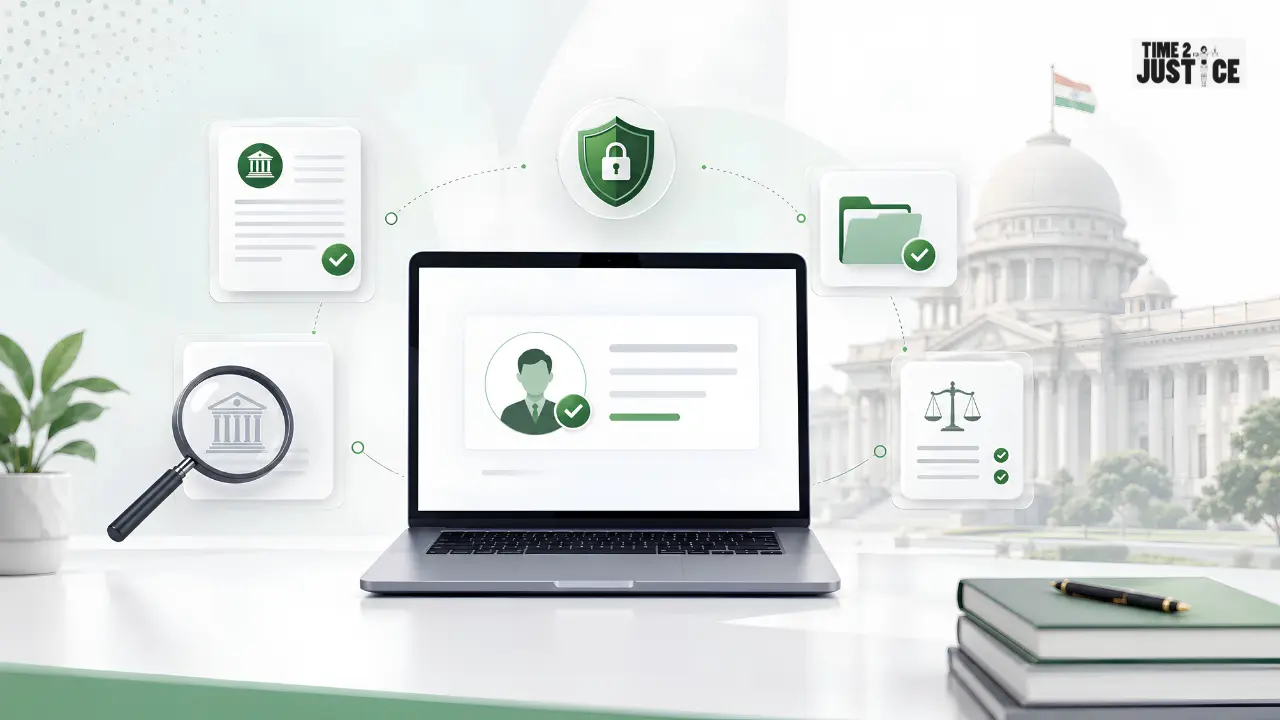
Criminal background check in India with digital identity and court record verification

Table of Contents

  • What Is a Criminal Background Check?
  • Criminal Record vs Court Case: Why It Matters
  • What Records May Be Relevant?
  • Where Are Court and Criminal Records Found in India?
  • Police Verification vs Court-Record Check
  • What Can an Online Criminal Background Check Reveal?
  • What May Not Appear?
  • Why Criminal Background Screening Matters for Employers
  • How AI Can Improve Background Screening
  • How to Run an Online Background Check With Time2Justice
  • Privacy and Legal Considerations
  • Conclusion
  • Frequently Asked Questions

A criminal background check in India can help employers, businesses, landlords and individuals make more informed decisions when safety and trust matter.

However, checking someone's legal history is not as simple as searching one central criminal-record database. Court information is available through different judicial systems, while FIR and police information can depend on the relevant jurisdiction and availability of digital records.

A reliable screening process therefore needs to consider the type of record, the person's role in the case, the case status, identity matching, and the scope of the databases searched.

This guide explains how criminal background checks work in India, what information may be available, how police verification differs from court-record screening and how online verification can simplify the process.

For a broader overview, read our Complete Guide to Background Checks in India.

Important: A court-record match does not automatically mean that a person committed a crime. An individual can appear in a case as a complainant, petitioner, respondent, defendant, accused, or another party. Every finding should be reviewed in its proper context. The official eCourts system supports these different party roles.

What Is a Criminal Background Check?

A criminal background check is a screening process used to identify available information related to an individual's involvement in criminal proceedings, court cases, FIR-linked matters, or other relevant legal records.

It differs from a general background check, which may also cover identity, address, employment, education, financial information, or other verification.

Depending on the scope of the check, it may identify:

  • Pending court cases
  • Disposed cases
  • FIR-linked court proceedings where available
  • Case status and procedural history
  • Court orders or judgments where available

The purpose is not simply to find a "criminal record." The information needs to be matched to the correct individual and reviewed according to the person's role and the status of the case.

Criminal Record vs Court Case: Why It Matters

A criminal record check in India should not be confused with simply finding someone's name in a court database.

The official eCourts system allows searches by party name. A person may appear as a petitioner, plaintiff, complainant, respondent, defendant, appellant, accused, or extra party. Therefore, a name appearing in a case does not by itself establish that the person committed an offence or was convicted.

Prateek Agrawal

About the Author

Prateek Agrawal

Co-founder, Time2Justice.ai | AI Strategy & Legal-Tech Architect

Prateek Agrawal is a computer engineer with a Master’s degree from Texas and the Co-founder of Time2Justice.ai, an AI-powered legal-tech platform focused on transforming how individuals and businesses access legal intelligence in India. He has also co-founded Ivy Professional School, a top-ranked AI upskilling and consulting platform for enterprises.

He works at the intersection of artificial intelligence, data systems, and legal workflows, building scalable AI solutions for legal research, dispute profiling, background verification, and organizational risk assessment.

Prateek writes about AI in law, digital justice infrastructure, legal data intelligence, and the future of AI-assisted decision-making. His goal is to make complex legal processes more transparent, accessible, and data-driven for citizens, businesses, and institutions.

Follow on LinkedIn

Related Posts

How PDF Comparison Works: Text, Visual & Structural Differences
August 17, 2026
How to Compare Scanned PDFs: OCR, Visual Comparison & Best Practices
August 12, 2026
AI Contract Comparison: Benefits, Process & Best Practices
August 10, 2026

Similarly, an FIR records information relating to an alleged offence. It should not automatically be treated as proof of guilt.

When a potential match is found, the screening process should consider:

  • The person's role in the case
  • The nature of the proceeding
  • Current case status
  • Relevant orders or judgments, where available
  • Whether the record actually belongs to the person being screened

This is particularly important when the information is being used for employment, rental, lending, or business decisions.

What Records May Be Relevant?

FIR-Related Information

An FIR records information relating to a cognisable offence reported to the police.

FIR information can be relevant to background screening, but an FIR should not be treated as a finding of guilt.

The eCourts system provides an FIR-number search, where users can search using the police station, FIR number and year, subject to the availability of the case in the system.

Court Proceedings

A criminal matter may proceed to court following investigation. Where relevant information is available in judicial records, a background check may identify the associated case and its procedural history.

The information available can vary depending on the court, jurisdiction, record, and stage of the proceeding.

Pending Cases

A pending case has not reached a final disposition.

A pending case should not be treated as a conviction. The case status, person's role, and relevance of the matter should be reviewed before drawing conclusions.

Convictions

A conviction means that a court has found an accused person guilty of an offence.

Where conviction information is available, it may be relevant to certain risk-sensitive decisions. However, organisations should consider the nature and relevance of the offence rather than treating every record in the same way.

Acquittals and Disposed Cases

A disposed case can have different outcomes, including acquittal.

An acquittal should not be presented as a conviction. Background-check results should clearly distinguish between the existence of a case and its final outcome.

Court Orders and Judgments

Court orders and judgments can provide additional context about a proceeding where they are available.

For example, the eCourts system provides a facility for searching court orders by party name and viewing available orders or judgments.

Where Are Court and Criminal Records Found in India?

India does not have one publicly searchable database containing every possible criminal-history record. Relevant information can instead come from different judicial and government systems.

eCourts

The official eCourts Services system provides case-status information and supports searches using details such as party name, case number, and FIR number. It can also provide available case history for matching records.

High Court Records

High Court systems provide information about cases and orders within their respective jurisdictions. Depending on the purpose of a screening, relevant High Court records may need to be considered.

Police and FIR Records

Police and FIR information is associated with relevant state and police systems. Availability and digitisation can vary by jurisdiction.

Therefore, an online search should not be presented as a guarantee that every historical FIR or police record will be identified.

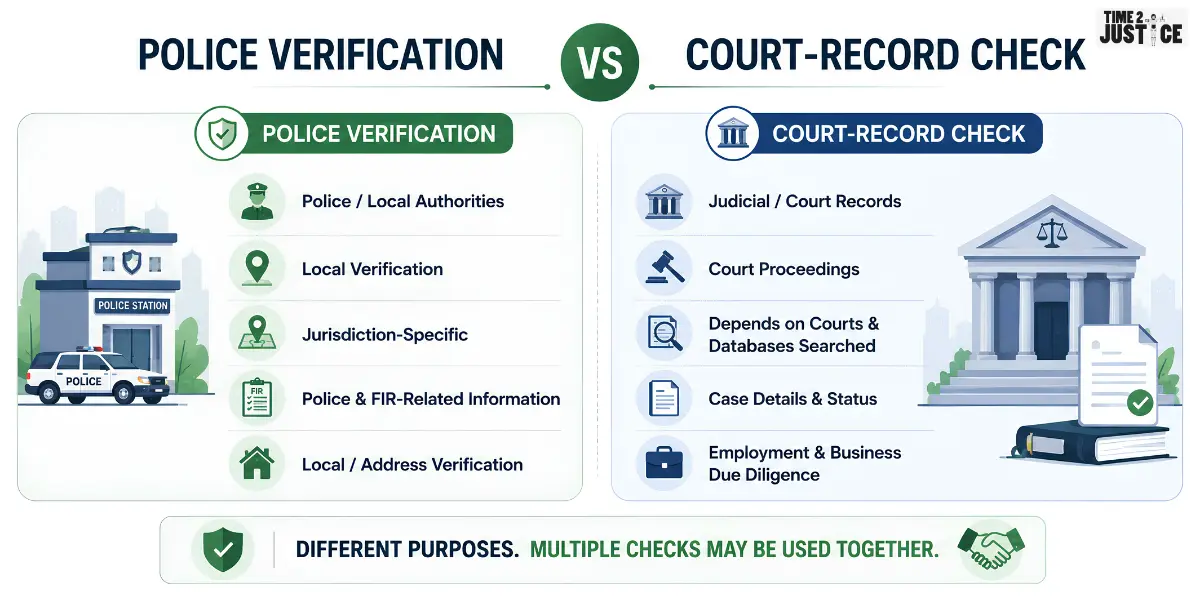
Police Verification vs Court-Record Check


Image

Police verification and court-record screening serve different purposes.

FactorPolice VerificationCourt-Record Check
Main sourcePolice/local authoritiesJudicial records
Main purposeLocal verificationReview of available court proceedings
CoverageDepends on jurisdictionDepends on courts and databases searched
InformationPolice/FIR-related information may be availableCase details, status, and orders where available
Common useLocal or address-related verificationEmployment and business due diligence

Police verification may be appropriate when verification through a local authority is required.

A court-record check focuses specifically on available judicial proceedings.

For some decisions, organisations may use multiple verification methods rather than treating one type of check as a complete substitute for another.

What Can an Online Criminal Background Check Reveal?

Depending on the databases and sources searched, an online screening may identify:

  • Court cases associated with a matching identity
  • Pending and disposed proceedings
  • FIR-linked court cases where available
  • Case status and procedural history
  • Available court orders or judgments

However, results depend on the information provided and the availability of records.

A common-name search can also produce potential false matches. Using additional identifying information, where appropriate and legally permissible, can help distinguish between individuals with similar names.

What May Not Appear?

A clean background-check result should not automatically mean that a person has never been involved in any legal matter.

Information may be unavailable because:

  • A record has not been digitised
  • The relevant database does not contain the information A case is very recent
  • The person's details do not sufficiently match the search information
  • The matter falls outside the scope of the databases searched

For this reason, responsible screening should clearly explain the scope and limitations of the search rather than promise that every possible record has been found.

Why Criminal Background Screening Matters for Employers

Criminal and court-record screening can be one part of a broader employee background-verification process.

Financial Roles

Employees handling company funds, financial accounts, or sensitive financial information may require additional due diligence.

IT and Data-Sensitive Roles

Positions involving confidential customer information, internal systems, intellectual property, or cybersecurity may require more extensive screening.

Healthcare and Education

Organisations working with children, patients, elderly people, or other vulnerable groups may have additional safeguarding considerations.

Retail and Operations

Businesses managing inventory, valuable goods, warehouses, or customer property may use background verification as part of their overall risk-management process.

A background-check result should not automatically determine whether someone is hired. Relevant findings should first be verified and reviewed in context.

How AI Can Improve Background Screening

Traditional screening can involve manually searching different systems and reviewing case information.

AI and digital verification tools can help make the process more efficient by:

Organising information: Available data can be presented in a structured format for easier review.

Supporting record matching: Technology can help identify potentially relevant records where individuals have similar names or details.

Simplifying case review: AI-assisted tools can help organise or summarise available case information.

However, AI should be treated as a screening and information-support tool, not as a replacement for legal judgment or a court's decision.

How to Run an Online Background Check With Time2Justice

Time2Justice offers AI-powered Background Verification services that include court case checks as part of its Individual Background Check.

The current Time2Justice pricing page lists the Individual Background Check at ₹1,199 per unit. It shows an Instant Online Check at ₹499, including a credit report and court cases check, while the Offline Background Check is ₹700 and includes physical field verification and address and identity checks.

To get started:

Step 1: Visit Time2Justice ID Verification.

Step 2: Select the relevant Background Verification service.

Step 3: Select the appropriate verification type — Individual for a person, Company for a business, or Others for other services such as a GST Report.

Step 4: Enter the required information and documents, where applicable.

Step 5: Complete the verification process.

Step 6: Review the available results.

The exact information available depends on the selected service, information provided, supported data sources, and applicable limitations.

For a detailed walkthrough, read our How to Run an Instant Background Check Online in India Using AI.

Privacy and Legal Considerations

Criminal background screening involves personal information, so organisations should handle it carefully and follow applicable privacy and data-protection requirements. Organisations should consider the requirements of India's Digital Personal Data Protection Act, 2023 when processing personal data for background verification.

Before conducting a background check, organisations should consider:

Having an appropriate legal basis for processing the information

  • Providing required notice
  • Obtaining consent where applicable
  • Using the information only for the intended purpose
  • Restricting access to authorised persons
  • Reviewing potentially inaccurate matches before making decisions

A court-case match should not be treated as proof of wrongdoing. Organisations should verify the match and review relevant case details before taking action.

Conclusion

A criminal background check in India can be an important part of responsible hiring, tenant screening, vendor due diligence, and other trust-based decisions.

However, an effective screening process involves more than searching someone's name. A court-case match is not automatically a criminal record, an FIR is not proof of guilt, and a clean online search cannot guarantee that no legal record exists.

The safest approach is to use appropriate sources, verify identity carefully, understand the person's role and case status, respect applicable privacy requirements, and treat background-check information as part of an informed decision rather than an automatic judgment.

Time2Justice provides online Background Verification services, including court case checks, to help users review available verification information more efficiently.

Frequently Asked Questions

What is the difference between a criminal background check and police verification in India?

Police verification generally involves verification through the relevant police or local authority, while court-record screening focuses on available judicial case information. They can serve different purposes and may be used together.

Can a criminal background check find every FIR in India?

No. FIR availability depends on the relevant police and court systems, jurisdiction, digitisation, and the scope of the search. An online search should not be presented as a guarantee that every FIR will be identified.

Does a court case mean someone has a criminal record?

No. A person may appear as a complainant, petitioner, respondent, defendant, accused, or another party. The role, case status, and outcome must be reviewed before drawing conclusions.

Does a background check show acquittals?

A court-record search may identify disposed cases and related information where those records are available. An acquittal should be clearly distinguished from a conviction.

How long does an online background check take?

The time depends on the verification type, information provided, databases searched, and whether additional verification is required. Digitised checks can be faster than manual verification, but no universal completion time should be assumed.

What should an employer do if a court record is found?

The employer should first verify that the record belongs to the candidate and understand the person's role, case status, and outcome. A record should not automatically be treated as proof of wrongdoing.

AI powered legal platform for all your legal needs

Try Time2Justice for Free

Ask a Legal QueryAI Background Check

AI powered legal platform for all your legal needs

Try Time2Justice for Free

Ask a Legal QueryAI Background Check